World Council of Churches

A worldwide fellowship of churches seeking unity, a common witness and Christian service

You are here: Home / What we do / Ecumenical perspectives on mission and unity

Ecumenical perspectives on mission and unity

This project brings the WCC's specific ecumenical perspective and experience to international dialogue and debate on mission and evangelism in the 21st century.
Ecumenical perspectives on mission and unity

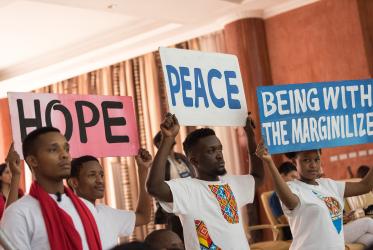
The WCC invites the churches to share reflections, insights and experiences as to how the churches can best be faithful to their mission and provide a common witness to Jesus Christ in all realms of life - personal, cultural and socio-economic.

It sees the mission challenges for the churches as finding a balance between a clear witness to the gospel, the respect for people's dignity, and solidarity with those who suffer, e.g. from exclusion, injustice or sickness. Mission emanates from worshipping churches and includes evangelism, the search for inclusive communities, various forms of healing ministries, as well as  covenanting for justice. In WCC's perspective, mission must be "in Christ's way" and strive for authentic reconciliation and peace, counting on the presence and power of God's healing Spirit, in particular in situations of religious plurality.

This project brings the WCC's specific ecumenical perspective and experience to international dialogue and debate on mission and evangelism in the 21st century.

As an institutional expression at the world level of the movement started at the 1910 Edinburgh World Mission Conference that led to the integration of church and mission, the WCC has played a leading role in organizing a common mission conference in June 2010 in Edinburgh, together with many stakeholders representing the changing face of contemporary world Christianity.

The WCC has likewise been involved in the first stages of an international, interdenominational and decentralized study on mission launched in preparation for the centennial. The project pursues this involvement; steps and content are being negotiated with partners beyond the WCC fellowship, including evangelicals, Pentecostals and Roman Catholic mission bodies.

WCC's own study work focuses on the link between evangelism and unity (including issues of church growth, conversion, proselytism); between mission and the healing ministry; and between ecclesiology and mission. WCC will also continue the search for a relevant spirituality in mission and in the struggle for justice.

New: WCC Evangelism Newsletter

Download a copy of the WCC newsletter on evangelism:

This issue of the WCC newsletter on mission and evangelism offers an insight on the New Affirmation on Mission and Evangelism of the World Council of Churches.
This new e-letter on Evangelism of the World Council of Churches comes as a response to the need to commit anew to Evangelism, in search of fresh approaches for the proclamation of the Word of God.

Related News

New mission statement part of European ecumenical study course

A new WCC document on mission and evangelism was presented and discussed at a recent European ecumenical study course in Josefstal, Germany.

WCC and partners strengthen relationship in advance of assembly

WCC and partners strengthen relationship in advance of assembly

The upcoming WCC 10th Assembly is not only a pivotal moment in the life of the global fellowship of 345 member churches but also a defining moment for the WCC and its programmatic and financial partners.

Catholic delegates reflect on WCC’s new mission statement

Catholic delegates reflect on WCC’s new mission statement

In a consultation held in Switzerland, delegates of the Pontifical Council for Promoting Christian Unity (PCPCU) pointed out “inspirations” as well as “challenges” in the new mission statement issued by the World Council of Churches (WCC) last year.

Related Documents

Together Towards Life: Mission and Evangelism in Changing Landscapes

The Commission on World Mission and Evangelism (CWME) has, since the WCC Porto Alegre Assembly in 2006, been working and contributing toward the construction of a new ecumenical mission affirmation. The new statement will be presented to the WCC 10th assembly at Busan, Korea, in 2013. Since the integration of the International Missionary Council (IMC) and the World Council of Churches (WCC) in New Delhi, 1961, there has been only one official WCC position statement on mission and evangelism which was approved by the central committee in 1982, “Mission and Evangelism: An Ecumenical Affirmation.” This new mission affirmation has been unanimously approved by the WCC Central Committee held in Crete, Greece on 5 September 2012. It is the aim of this ecumenical discernment to seek vision, concepts and directions for a renewed understanding and practice of mission and evangelism in changing landscapes. It seeks a broad appeal, even wider than WCC member churches and affiliated mission bodies, so that we can commit ourselves together to fullness of life for all, led by the God of Life!