World Council of Churches

A worldwide fellowship of churches seeking unity, a common witness and Christian service

You are here: Home / What we do / Commission on World Mission and Evangelism

Commission on World Mission and Evangelism

The contemporary missionary movement has been one of the major streams fostering ecumenism ever since the world mission conference in Edinburgh in 1910. When the International Missionary Council (IMC), one of the outcomes of Edinburgh, merged with the World Council of Churches in 1961, the programmatic work and responsibility of the IMC became entrusted to the WCC.

A three-fold structure was created within WCC as a consequence of the merger:

In the CWME conferences, the WCC is already experiencing a form of 'wider ecumenism' with the full participation of delegates from the Roman Catholic Church, and evangelical or Pentecostal churches or mission movements.

The CWME commission is composed of some 25 members, also coming from WCC member churches,  mission bodies affiliated to the CWME conference and representatives of the 'wider ecumenism'. Roman Catholics, evangelicals and Pentecostals are full members of the CWME commission and participate in all its activities.

Methods

The Commission intends to offer spaces to churches and people or movements engaged in mission and evangelism for sharing reflections, experiences, questions and discoveries on content and methods of Christian witness today. The main concern is to empower churches and mission bodies to be in common mission and to do it in Christ's way, i.e. linking the methods used with the content of the gospel.

CWME fosters conferences, consultations, study processes, publications and visits, correspondence or other forms of contacts.

Themes

In the run-up to the Edinburgh 1910 centennial, major thematic foci are

  • the relation between mission and unity, or between the church and mission (a study will be done in cooperation with the Faith and Order Commission)
  • the theology of evangelism in a world of religious plurality. This will involve a new reflection on the significance of evangelism and on  methods of sharing the gospel. CWME is also participating together with other programmes of the WCC and the Roman Catholic Church, the World Evangelical Alliance and Pentecostals in the search for a "code of conduct on conversion"
  • the search for a spirituality of mission as healing and transformation
  • the reflection on Christian identity in a world of religious plurality (also in cooperation with other programmes of the WCC)

    Related News

    New mission statement part of European ecumenical study course

    A new WCC document on mission and evangelism was presented and discussed at a recent European ecumenical study course in Josefstal, Germany.

    Proclaiming God of life entails mission from the margins

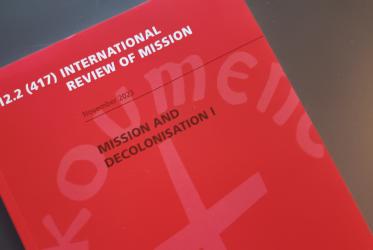
    “The urgency of life today” drives Christian engagement in mission, say ten contributors to a new issue of the International Review of Mission, which links the new paradigm of mission to the theme of the upcoming WCC assembly.

    Churches seek renewed commitment to evangelism

    Churches seek renewed commitment to evangelism

    On 24 March 2012, the World Council of Churches (WCC) Commission on World Mission and Evangelism pre-assembly event invoked renewed thinking and commitment on evangelism, disassociated from the forces of oppression, and grounded in humility and respect for all.

    Related Documents

    Together Towards Life: Mission and Evangelism in Changing Landscapes

    The Commission on World Mission and Evangelism (CWME) has, since the WCC Porto Alegre Assembly in 2006, been working and contributing toward the construction of a new ecumenical mission affirmation. The new statement will be presented to the WCC 10th assembly at Busan, Korea, in 2013. Since the integration of the International Missionary Council (IMC) and the World Council of Churches (WCC) in New Delhi, 1961, there has been only one official WCC position statement on mission and evangelism which was approved by the central committee in 1982, “Mission and Evangelism: An Ecumenical Affirmation.” This new mission affirmation has been unanimously approved by the WCC Central Committee held in Crete, Greece on 5 September 2012. It is the aim of this ecumenical discernment to seek vision, concepts and directions for a renewed understanding and practice of mission and evangelism in changing landscapes. It seeks a broad appeal, even wider than WCC member churches and affiliated mission bodies, so that we can commit ourselves together to fullness of life for all, led by the God of Life!